

 Laura Anderson
A personal awareness story about a rare pregnancy complication that nearly went undetected
Pregnancy is often described as a beautiful journey. But not every pregnancy progresses normally. Some conditions are rare, dangerous, and barely discussed. One of them is molar pregnancy, also known as hydatidiform mole.
I am sharing my experience because many women suffer silently without knowing the symptoms. I was one of them. And I almost missed it.
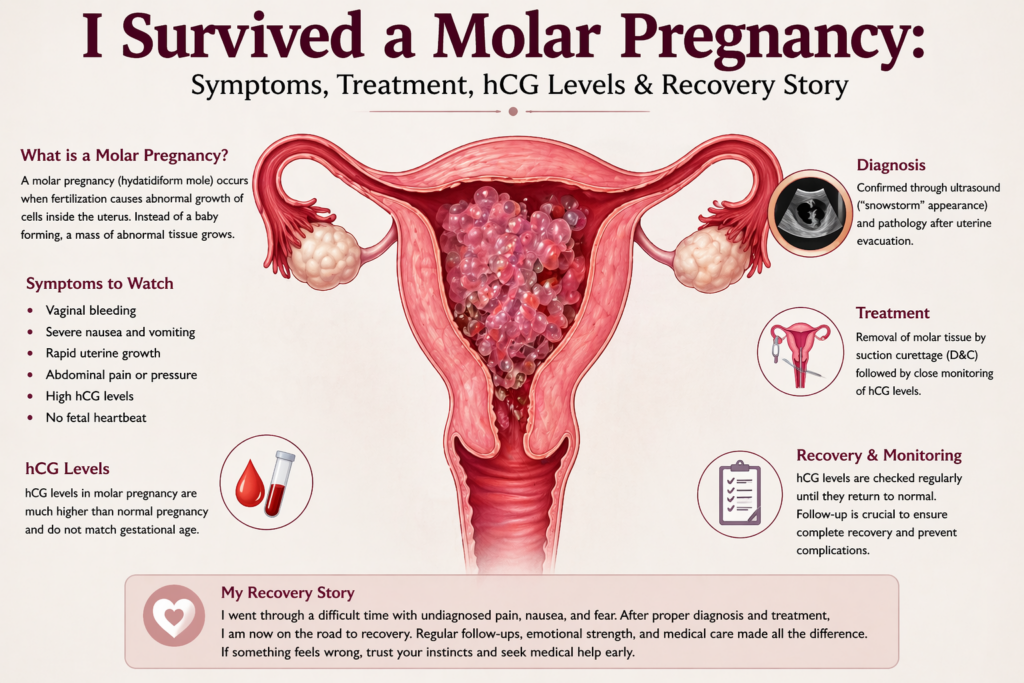
What Is a Molar Pregnancy?
A molar pregnancy happens when a fertilized egg develops abnormally. Instead of a healthy placenta and baby growing normally, abnormal tissue develops inside the uterus.
There are two types:
- Complete molar pregnancy – no fetus develops at all
- Partial molar pregnancy – abnormal fetal tissue may form, but the pregnancy cannot survive normally
This condition requires urgent medical attention. It is not a miscarriage. It is not a normal pregnancy loss. It is a separate medical condition that must be diagnosed and treated properly.
What I Felt: My Body Was Telling Me Something Was Wrong
From early on, I knew something was not right.
I could physically feel discomfort deep inside my stomach. Even after eating, I felt unusual internal pressure. I could almost sense food moving unnaturally deep inside my body. It did not feel like normal pregnancy discomfort.
I had:
- Constant nausea with a vomiting sensation, but often no actual vomiting
- Extreme weakness and exhaustion
- Difficulty getting up in the morning
- Inability to carry out daily routines
- Persistent, deep abdominal pain
- A strong internal feeling that something was seriously wrong
Women should trust their instincts. Sometimes the body signals a problem long before tests confirm it.
Why Molar Pregnancy Is Difficult to Diagnose
This is one of the most important things I want women to understand about molar pregnancy symptoms.
Molar pregnancy can be extremely difficult to detect early. In my case, doctors initially could not locate the abnormal tissue clearly. Scans were unclear. Blood tests did not fully explain the symptoms. The tissue had grown deeper than expected, making it harder to identify.
Eventually, doctors discovered the abnormal pregnancy tissue had grown beyond the uterus into surrounding areas, which made treatment far more complex. I underwent surgery that lasted nearly two and a half hours.
The medical team successfully removed all the abnormal tissue, including every cyst. Today, I am safe.
Understanding hCG Levels in Molar Pregnancy
hCG, or human chorionic gonadotropin, is the hormone produced during pregnancy. In a molar pregnancy, hCG levels go dangerously high and become one of the most important diagnostic clues.
Here is what normal versus molar pregnancy hCG levels typically look like:
Normal pregnancy hCG reference ranges:
- 4 weeks: 5 – 426 mIU/mL
- 5 weeks: 18 – 7,340 mIU/mL
- 6 weeks: 1,080 – 56,500 mIU/mL
- 7–8 weeks: 7,650 – 229,000 mIU/mL
- 9–12 weeks: 25,700 – 288,000 mIU/mL
In molar pregnancy:
- hCG commonly exceeds 100,000 mIU/mL
- In many cases it rises above 200,000 – 300,000 mIU/mL
- Levels are significantly higher than expected for the gestational age
- The abnormally high reading itself is a red flag that must be investigated immediately
In my case, my hCG levels were extremely elevated. This was one of the clearest signs that something was seriously wrong, even when scans were not yet giving clear answers.
Molar Pregnancy Treatment: What Actually Happens
Once a molar pregnancy is confirmed, treatment must begin without delay. Here is what the standard molar pregnancy treatment process looks like, and what I personally went through.
Step 1 – Suction Curettage (D&C)
The first line of treatment for most molar pregnancies is a procedure called suction curettage, commonly known as a D&C (dilation and curettage). The doctor removes all abnormal tissue from the uterus through the cervix. This is done under anaesthesia and is usually the primary treatment for early-stage cases.
Step 2 – Surgery for Advanced or Complex Cases
In cases where the abnormal tissue has grown deeper into the uterine wall or spread to surrounding areas, surgery becomes necessary. This is what happened in my case.
My surgery lasted nearly two and a half hours. The doctors worked to locate and completely remove all abnormal tissue and cysts, including tissue that had grown beyond where standard procedures could reach. It was complex, it was serious, and it was the reason I am alive and well today.
Step 3 – Pathology and Confirmation
After removal, all tissue is sent for pathology testing. This confirms the type of molar pregnancy, whether complete or partial, and checks for any signs of invasive growth or spread.
Step 4 – Chemotherapy (If Required)
In cases where molar pregnancy develops into gestational trophoblastic disease, GTD, or if tissue spreads to other organs, chemotherapy may be required. This is more common when:
- hCG levels do not fall after surgery
- Abnormal tissue is detected in other organs such as the lungs
- The condition progresses to choriocarcinoma, a rare but treatable cancer
Not every woman with molar pregnancy needs chemotherapy. But every woman needs close follow-up monitoring to rule it out.
Step 5 – hCG Monitoring After Treatment
This step is not optional. After treatment, hCG levels are tested regularly, weekly or fortnightly, until they reach normal. Doctors use these numbers to confirm that no abnormal tissue remains active in the body.
My hCG Recovery Timeline: 3 Months to Reach Normal
After surgery and the complete removal of all abnormal tissue and cysts, my hCG levels after molar pregnancy did not drop overnight.
It took a full 3 months of regular monitoring for my hCG levels to finally come down to the normal range.
This is important for every woman to know:
- After treatment, hCG is tested weekly or fortnightly
- The target is for levels to fall consistently and reach below 5 mIU/mL, which is considered normal or undetectable
- If levels stop falling at any point, it is a warning sign
- If levels plateau or rise again, it may mean abnormal tissue remains and further treatment is needed
Those 3 months were a waiting period filled with tests, monitoring, and patience. Every drop in the number was a small victory. Reaching normal was the moment I finally felt free.
Do not be alarmed if your molar pregnancy recovery time takes weeks or months. What matters is that the numbers are consistently moving downward.
Molar Pregnancy Warning Signs Women Should Never Ignore
Please seek urgent medical help if you experience any of the following:
- Heavy or unusual vaginal bleeding
- Severe nausea with or without vomiting
- Deep abdominal or pelvic pain
- Extreme weakness or inability to function normally
- Rapid uterine enlargement
- Abnormal ultrasound results
- hCG levels higher than expected for your stage of pregnancy
- Symptoms continuing or worsening after a miscarriage or pregnancy loss
A Personal Message About Fertility Treatment and Molar Pregnancy
This is my personal view based on lived experience.
I underwent IUI before this happened. My sincere advice is: do not rush into fertility treatments like IVF or IUI without a thorough medical evaluation first.
Before any fertility procedure, please discuss with your doctor:
- Hormone health and hCG baseline
- Uterine health and structure
- Ovarian condition
- Full reproductive assessment
- Any previous pregnancy history or losses
Patience and a proper diagnostic pathway are not delays. They are protection.
Why I Am Speaking Up About Molar Pregnancy
Many women go through rare pregnancy complications in complete silence because these conditions are not openly discussed. There is no widespread awareness. There are no mainstream conversations about hydatidiform mole or partial molar pregnancy.
I want that to change.
If my story helps even one woman recognise molar pregnancy symptoms earlier, seek care faster, or ask the right questions before a fertility procedure, then sharing this is worth every word.
Final Message
If something feels wrong during your pregnancy, do not dismiss it.
Ask questions. Request tests. Demand follow-up. Seek second opinions if needed.
I recovered because the condition was eventually identified and treated in time. The surgery was long and difficult. It took 3 months after surgery for my body to fully return to normal hCG levels. But I got there. And you can too.
You know your body. Trust it.
This article is based on a personal experience and shared for public awareness. It is not a substitute for professional medical advice. If you have concerns about your pregnancy, please consult a qualified healthcare provider.